> For the complete documentation index, see [llms.txt](https://cvnnt.gitbook.io/documentation/llms.txt). Markdown versions of documentation pages are available by appending `.md` to page URLs; this page is available as [Markdown](https://cvnnt.gitbook.io/documentation/security-model/system-validation-logic-separation.md).
# System validation logic separation
{% hint style="info" %}
Hyperliquid is used as an example of EVM blockchain.
{% endhint %}
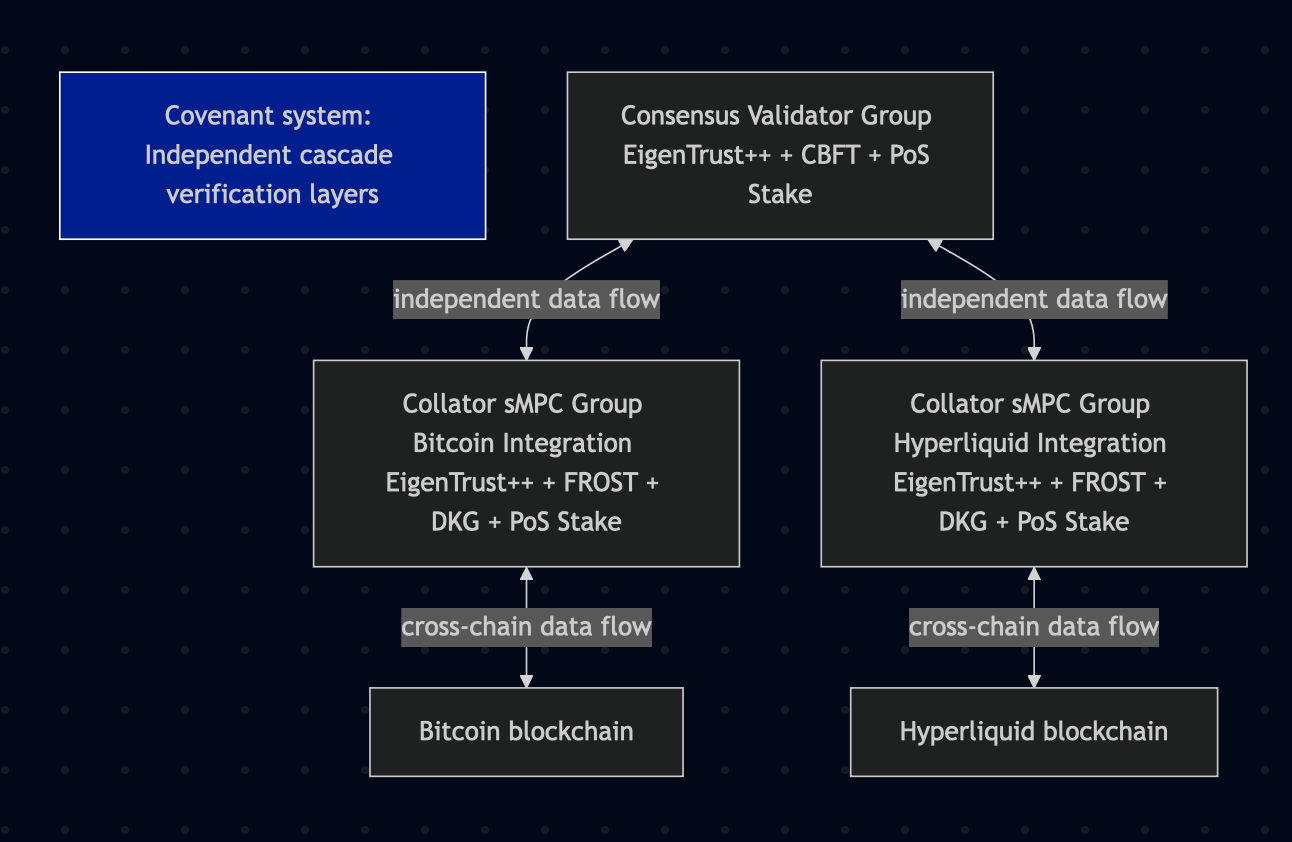
Covenant layered architecture with and deterministic cascade process flow supposes clear separation of logic and isolated roles between Validator and Collator master nodes.
#### Validator master nodes
* Purpose: Achieve global distributed agreement on Covenant’s Middleware state and data production;
* Algorithm: CBFT with EigenTrust++ reputation + PoS stake;
* Scope: Entire Covenant system state.
#### Collator master nodes
* Purpose: Verify and execute cross-chain operations securely using threshold signatures;
* Algorithm: FROST with Distributed Key Generation (DKG + PoS stake) + EigenTrust++ reputation + PoS stake;
* Scope: Dedicated per each integration - e.g., one Collator sMPC group logic for handling Bitcoin integration, another for handling Hyperliquid integration.
Validation master node groups and roles do not intercept or overlap with each other’s activities. Validators cannot interfere with Collator signing, and Collators cannot affect Middleware consensus.
Collators as well as Validators have their grouping processes and epochs. However, for each role (Validators, Bitcoin Collators, Hyperliquid Collators) these processes are isolated and run in parallel.
Figure 1. Covenant system group logic separation: Independent cascade verification layers
### Security Rationale for Validator and Collator Role Separation
The separation of consensus Validator set and Collator sMPC groups is a deliberate design choice that due the layered approach further reduces systemic risk:
* **Compartmentalization of Trust**: A compromise in one collator group (e.g., Bitcoin integration) does not affect other integrations (e.g., Hyperliquid) or the Covenant consensus itself.
* **Minimized Blast Radius:** Attacks on cross-chain signing infrastructure cannot propagate into global consensus or impact unrelated integrations.
* **Reduced Collusion Possibility:** Validators and collators serve different purposes with different membership rotations, making it impossible for a single entity to dominate both (all) layers.
* Auditable Separation of Duties: Each group has transparent, role-specific operations, allowing independent auditing and monitoring by Witness groups or any interested party.
This separation ensures that Covenant’s cross-chain operations are compartmentalized, resilient, and independently verifiable, maintaining trust without widening the attack surface.\