> For the complete documentation index, see [llms.txt](https://cvnnt.gitbook.io/documentation/llms.txt). Markdown versions of documentation pages are available by appending `.md` to page URLs; this page is available as [Markdown](https://cvnnt.gitbook.io/documentation/how-it-works/13q-78drafts.md).
# 13q\*78Drafts
Covenant system utilizes set of proven, secure, established algorithms for safe operations of Covenant distributed system.
**System update Jul-18-2026:** Covenant system evolves with adding ZKP shielding layer to provide modular and scalable privacy management options with user-owned setups.
multidimensional
### Why EigenTrust++ delivers security & robustness
EigenTrust++ directly addresses and eliminates key vulnerabilities in the original EigenTrust, including weaknesses in local trust computation, global aggregation, and eigenvector-based propagation, replacing them with mechanisms designed from the ground up to withstand dishonest ratings, feedback manipulation, sparse connectivity, and coordinated attacks.
Key security enhancements include:
* Inherent resistance to dishonest feedback – counters malicious rating inflation/deflation even when adversaries provide consistently false opinions.
* Strong defense against collusion & strategic attacks – makes coordinated reputation boosting (e.g., mutual praise cartels) economically prohibitive and detectable, requiring broad, genuine peer support rather than small-group manipulation.
* Proven robustness in sparse & adversarial networks – maintains accurate trust propagation under low connectivity or high churn, unlike the original EigenTrust which degrades significantly.
* Battle-tested attack resilience – extensive evaluations demonstrate EigenTrust++ significantly outperforms EigenTrust across multiple representative attack models (individual malicious actors, colluding groups, camouflage, Sybil-like behaviors), delivering higher performance and dramatically better isolation of bad actors.
These improvements stem from an advanced eigenvector-based model with probabilistic threshold propagation and alternative aggregation techniques – making reputation scores tamper-proof by design: no single node (or small coalition) can meaningfully inflate its own global trust without widespread honest validation.
Security Benefits in Covenant Governance
High reputation remains permissionless yet rigorously merit-based – earned only through sustained honest interactions across a diverse peer set – while being extremely difficult to fake or game.
This results in:
* Powerful Sybil resistance – malicious actors cannot cheaply flood the network with fake identities to dominate consensus, as reputation demands broad, long-term peer endorsement.
* High-confidence governance – only nodes with proven, attack-resilient reputation qualify as master nodes, ensuring governance is dominated by honest, reliable participants.
* Dynamic accountability – reputation is subject to slashing for proven misbehavior, reinforcing incentives and enabling rapid isolation of threats.
By integrating EigenTrust++ – one of the most rigorously attack-hardened decentralized reputation algorithms available – Covenant establishes a foundationally secure governance layer: robust against manipulation, collusion, and subversion, even under sustained adversarial pressure. This delivers a trustworthy, high-integrity network that stands out for long-term resilience and investor confidence.
\===
Core Innovation: EigenTrust++
EigenTrust++ builds on EigenTrust's eigenvector-based transitive trust propagation, delivering significant improvements in:
* Resilience to dishonest feedback and collusion attacks
* Robustness in sparse or adversarial network conditions
* Overall reliability for decentralized rating aggregation
Nodes rate each other after interactions → local ratings aggregate into global reputation scores that are tamper-proof and computationally expensive to fake.
Key Advantages for Covenant Governance
High reputation is fully permissionless and merit-based – any node can earn elite status through:
* Consistent honest behavior over extended periods
* Broad, genuine interconnections with other nodes
Reputation is:
* Self-determined impossible – A node cannot inflate its own score; it depends entirely on peer evaluations.
* Collusion-resistant - Requires coordinated positive ratings from a large, diverse set of nodes, making attacks economically prohibitive.
* Sybil-resistant – Strongly deters malicious actors from flooding the network with fake identities to dominate consensus.
Critical Role in Covenant
A minimum reputation threshold is required for nodes to qualify as master nodes and participate in governance – ensuring only proven, reliable participants influence protocol decisions.
The reputation system delivers multiple network-level benefits:
* Enables fair, efficient interactions (especially rapid, trustworthy syncing for new nodes)
* Provides robust defense against Sybil attacks attempting consensus takeover
* Maximizes the probability of honest, aligned governance participants
Accountability via Slashing
Reputation is dynamic and enforceable – scores are subject to slashing upon proven misbehavior, creating strong economic incentives for integrity and deterring malice.
This EigenTrust++-powered reputation layer forms a cornerstone of Covenant's secure, decentralized governance model – combining permissionless access with battle-tested attack resistance to foster a trustworthy, high-integrity network attractive for long-term participation and investment.
\===
### Covenant system architecture
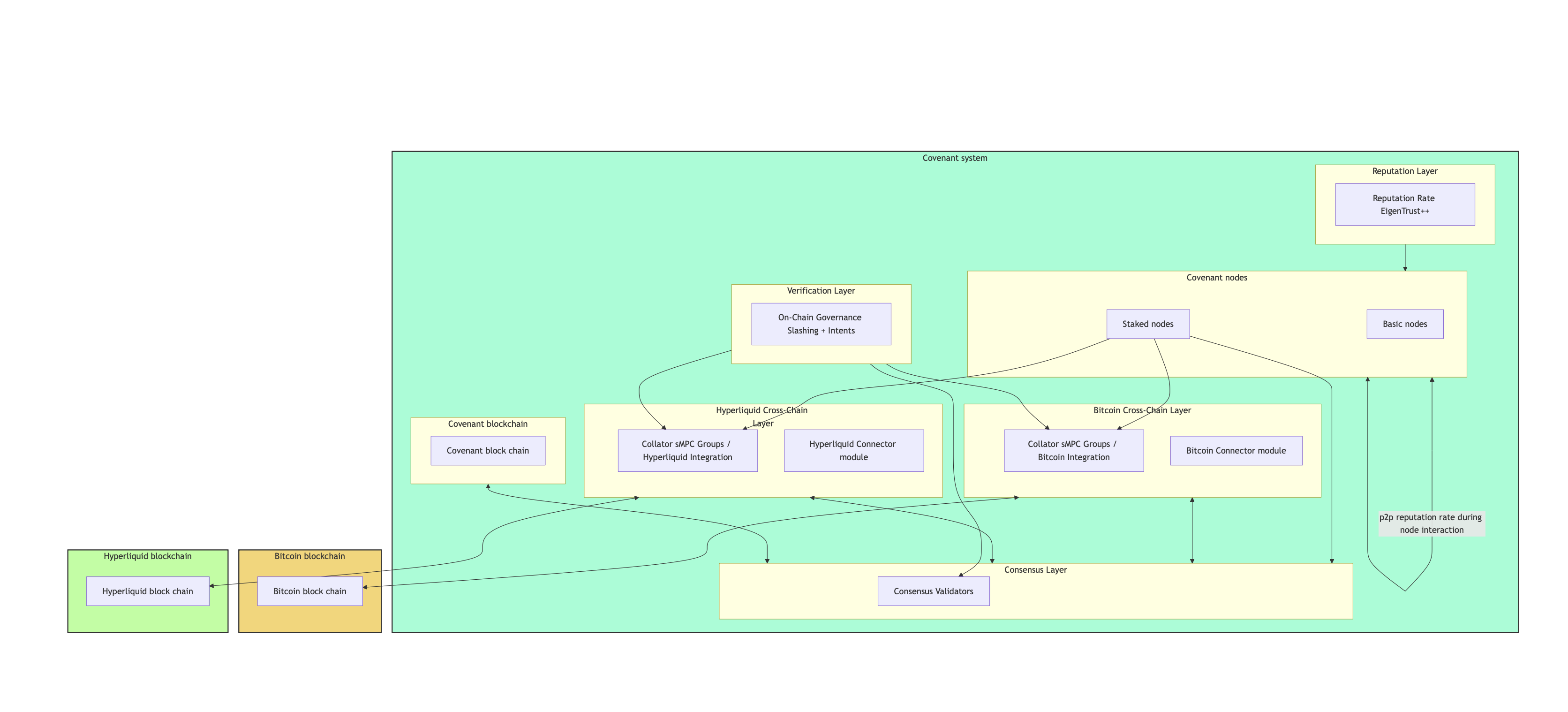
Covenant system is a distributed deterministic auxiliary system for Bitcoin that provides full EVM programmability and secure cross-chain liquidity to native Bitcoin without soft-forks, wrapping, custody risks, bridges, or centralized federations.
The architecture is deliberately composed of two integrated subsystems:
#### 1. Distributed Middleware State Management System
The core execution and settlement layer.
| Component | Role | Key Properties |
| ----------------------------------------- | -------------------------------------------------------------------------------------------------- | ------------------------------------------------------------------------------------------------------------------------ |
| Distributed Data Middleware Ledger (DDML) | Bitcoin Core-derived UTXO data and asset ledger for verifying state of operations |
• 1:1 native Bitcoin compatibility
• No soft-fork required
• Full Bitcoin-grade security & finality
|
| Intrinsic EVM Runtime Environment | Unmodified Ethereum EVM executing directly on top of the UTXO set |
• Turing-complete
• MetaMask-native
• All existing account tooling and contracts work unchanged
|
| Data processing UTXOEVM Sequencer Engine | Deterministic real-time data transmission module that builds and maintains an EVM-native MPT state |
• Atomic consistency
• Deterministic data transfer • State roots provably anchored to the UTXO set
|
Result: every smart-contract operation and every BTC deposit is represented as a real Bitcoin UTXO, yet fully programmable via standard EVM interfaces.
#### 2. Bridgeless Chain-Agnostic Cross-Chain Integration Modules
The cross-chain liquidity distribution layer that makes native Bitcoin value available on any EVM ecosystem.
| Component | Role | Key Properties |
| :-----------------------------: | :----------------------------------------------------------------------------------------------------: | :--------------------------------------------------------------------------------------------------------------------: |
| Per-chain Cross-Chain Connector | Covenant smart contract module that maintains a verified replica of the target chain’s finalized state |
• Uses the target chain’s own finality rules
• Chain-agnostic design
• No light-client complexity
|
Result: users move real BTC liquidity (via channel\_NFT + hBitcoin) to and from any integrated EVM chain in a completely trustless, wrapless, and instant-exit manner.
#### High-Level Covenant System Diagram
Outcome of the combined architecture
* Users retain 100 % self-custody of real Bitcoin at all times
* Full Ethereum-grade DeFi programmability is available on native BTC
* Liquidity flows instantly and trustlessly to and from any EVM chain
* No bridges, wrappers, federations, new tokens, or external consensus risks
Covenant is therefore the minimal programmed distributed system that makes Bitcoin the universal, programmable, self-custodial base participant for all of DeFi
General Covenant system architecture. Hyperliquid here serves as an example of EVM (account-based) network.